
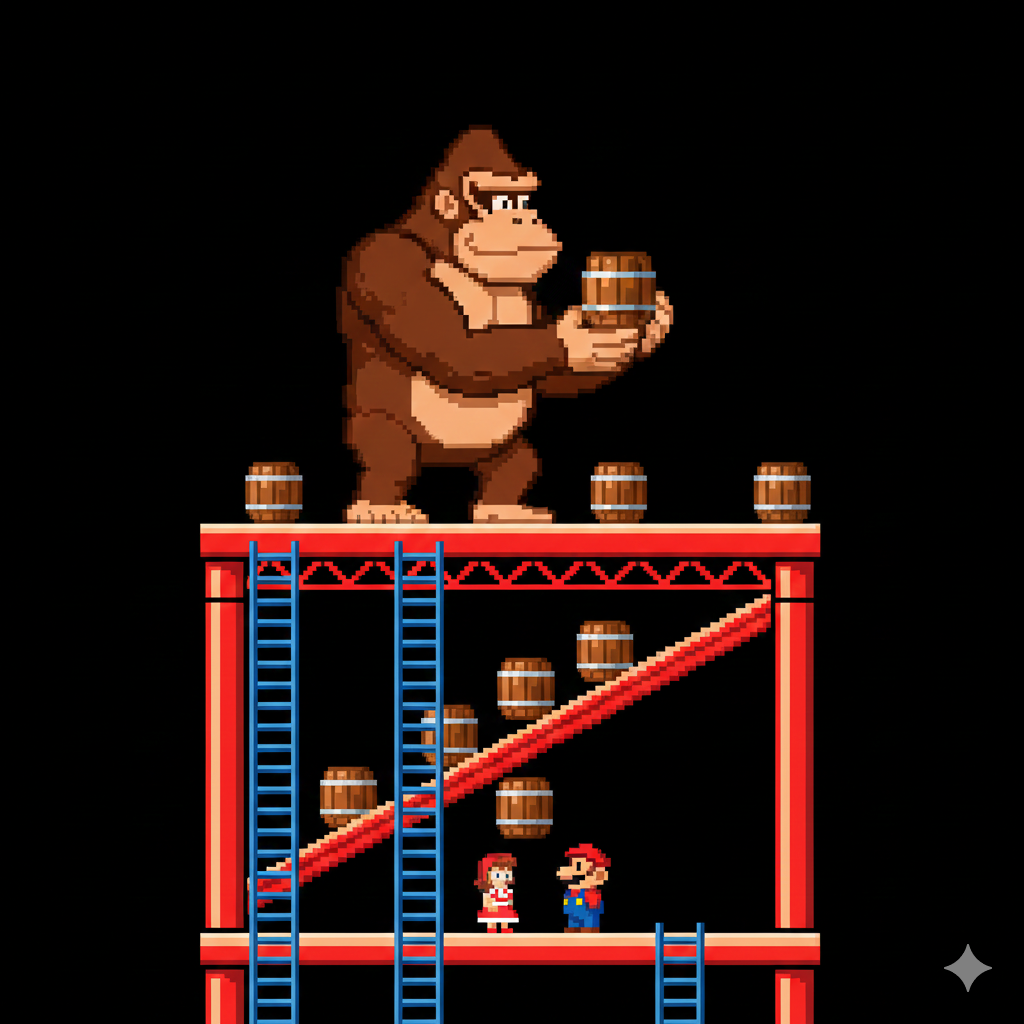
In the crowded, smoke-filled arcades of 1983, amidst the bleeps and bloops of spaceships and ghosts, one game stood out not just for its challenge, but for its story. It wasn’t just about high scores; it was about a girl, a hero, and an angry ape. This was Donkey Kong, and it didn’t just capture quarters—it captured imaginations and single-handedly redirected the course of video game history.
A Barrel of Trouble
The premise was revolutionary in its simplicity. The giant ape, Donkey Kong, has kidnapped the fair Lady (later known as Pauline). Her only hope is Jumpman (soon to be Mario), a mustachioed carpenter who must ascend a multi-tiered steel construction site. His path is blocked by a barrage of rolling barrels, fireballs, and bouncing springs. Each level—the iconic 25m Barrel Stage, the rivet-scattered Girder Stage, the conveyor belt Elevator Stage, and the final Pie Factory—introduced new platforming puzzles. The controls (run and jump) were perfectly tuned, demanding pixel-perfect timing and relentless focus. This was platforming perfection, a genre blueprint drawn in vibrant, chunky pixels.
More Than a Game A Cultural Touchstone
For a generation, Donkey Kong was an obsession. The distinctive four-note staccato of the opening riff is forever burned into memory. The sight of Jumpman’s death animation—arms flailing, plummeting into nothingness—was a shared trauma. Beating the first level brought a surge of triumph; reaching the infamous kill screen at Level 22 (due to a programming bug) was a badge of honor.
The game transcended the arcade. It became a playground topic, a puzzle to be solved collaboratively. Kids debated strategies for the tricky springboard jumps and the dreaded fireball floor. The characters, despite their limited animations, had personality Kong’s smug smirk, Jumpman’s determined sprint, the damsel’s desperate waving. It felt like a Saturday morning cartoon you could control.
The Architect of an Empire
Behind the screen, Donkey Kong’s legacy is even more profound. It was the breakthrough hit for a fledgling Nintendo, saving the company’s American ambitions from ruin. It single-handedly resurrected the arcade industry in the early 80s, proving there was still massive appetite for novel gameplay. It introduced the world to Shigeru Miyamoto, a young designer whose focus on character and whimsical charm would define Nintendo for decades.
Most importantly, it gave us Mario. The jump from Jumpman to the world’s most famous plumber began here. Donkey Kong, too, would evolve from villain to anti-hero and beloved icon. The game spawned direct sequels (most notably the groundbreaking Donkey Kong Jr.), but its true progeny is the entire Nintendo universe.
The 1983 Verdict Apex Predator
In the landscape of 1983, Donkey Kong was king. It competed with titans like Pole Position and Dragster, but it offered something they didn’t a persistent narrative goal. You weren’t just racing or shooting; you were on a rescue mission. Its perfect blend of escalating challenge, iconic audiovisuals, and character-driven design made it more than a pastime—it was an event.
Today, Donkey Kong isn’t just a relic; it’s a monument. It sits at the root of the platforming genre, the starting point for gaming’s most beloved franchise, and a testament to the power of creative vision. It reminds us that the simplest ideas—jump over the thing, save the person—can, when executed with genius, become timeless. Forty years on, the sight of that steel girder and the sound of those rolling barrels still quickens the pulse. The king of 1983 remains a sovereign of fun.