
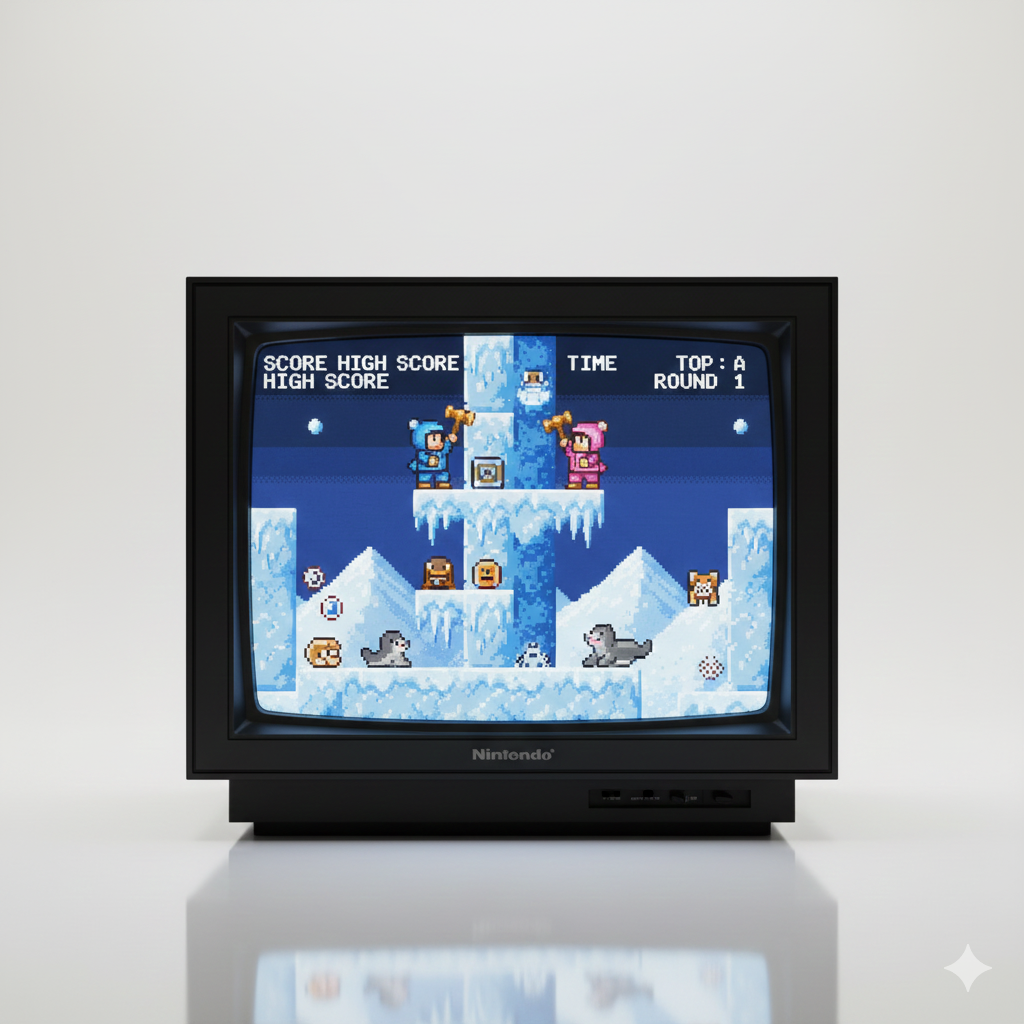
Introduction to Ice Climber
Nintendo’s Ice Climber, released in 1985, stands as a notable title in the realm of video games, marking a significant step in the evolution of platform games. Developed for the Famicom and later for the Nintendo Entertainment System (NES), this game introduced players to the icy landscapes filled with challenging gameplay elements. The premise revolves around two protagonists, Popo and Nana, who embark on a journey to conquer snowy peaks and rescue stolen vegetables from a rather peculiar penguin antagonist.
The gameplay experience in Ice Climber is characterized by its cooperative two-player mode, allowing friends to join forces to navigate through a series of vertically ascending levels. Each level provides a distinct blend of adventure as players use their mallets to break ice blocks, defeat enemies, and ascend while avoiding pitfalls. This unique mechanic encourages teamwork and strategy, enhancing the gameplay experience. The ability to play solo or cooperatively was innovative for its time and has greatly influenced the design of subsequent multiplayer games.
Ice Climber also left a legacy through its memorable pixel art style and catchy background music, resonating with players who appreciated its retro charm. The game’s influence extended beyond its initial release, as it was eventually included in various compilations and was made available on modern platforms, ensuring its legacy remains intact. In today’s gaming context, Ice Climber is often remembered not just for its nostalgic value but also for its role in establishing core mechanics that would be adopted and refined by future platforming titles.
Gameplay Mechanics and Features
Nintendo’s “Ice Climber” was innovative in its gameplay, offering a unique experience for players in 1985. The primary objective of the game revolves around ascending a series of ice-covered mountains, each filled with obstacles and challenges. Players control either Popo or Nana, two ski-clad climbers, whose goal is to reach the top of each iceberg. Success hinges not only on navigating the icy terrain but also on managing hazards that can impede progress.
The controls in “Ice Climber” are straightforward, allowing players to move left or right and jump. An early implementation of a climbing mechanism, players can also break blocks of ice above them to create new paths. This feature introduces strategic elements, as players must decide when to break blocks to create a safe ascent while also being careful of falling ice. Level design plays a notable role; each mountain comes with a unique arrangement, ensuring that players experience varied challenges as they scale higher peaks.
Multiplayer elements enhance the game’s appeal, as two players can team up to tackle the mountains simultaneously. This cooperative dynamic fosters camaraderie, as players support one another in overcoming the adversities presented by the game’s layout. The introduction of power-ups is another key aspect, providing players with much-needed enhancements to their climbing capabilities, such as speed boosts or temporary invincibility.
Throughout the journey, players encounter various adversaries, including angry birds and other antagonistic creatures that can halt progress. These elements not only boost the game’s challenge but also engage players in combat, balancing the game’s climbing mechanics with action-packed sequences. Overall, “Ice Climber” stands out for its blend of climbing dynamics, cooperative play, and innovative features that resonated with audiences at the time.
Cultural Impact and Reception
Nintendo’s Ice Climber, released in 1985, has made a notable impact on the gaming community and continues to influence titles today. As one of the earlier platforming games, its mechanics and design set the stage for many successors in the genre. With its cooperative gameplay, it fostered a shared experience uniquely suited for arcade settings and home consoles alike, positioning it as a precursor to future multiplayer gaming experiences.
The game introduced players to the challenges of vertical climbing, requiring not just dexterity but also strategy in navigating through various levels while battling enemies and overcoming obstacles. Critics initially praised its innovative approach to cooperative play; however, their opinions on the game’s execution varied. While some heralded its charm and simplicity, others critiqued its repetitive nature and somewhat minimalist graphics.
In retrospect, Ice Climber is credited with influencing several renowned franchises within Nintendo itself, including elements seen in Super Mario and Smash Bros.. Characters from the game, the Ice Climbers, found a second life in Super Smash Bros., bringing these nostalgic figures into the modern gaming landscape. Player testimonials often reminisce about the game’s challenge and cooperative dynamic, showcasing its lasting appeal and how it has fostered a sense of camaraderie among players.
Ultimately, Ice Climber may not have been the most commercially successful title of its time, but its legacy within Nintendo’s offerings and the broader video game culture is undeniable. By laying a foundation for future cooperative gameplay and platforming dynamics, it has ensured that this classic remains a beloved installment in Nintendo’s storied history.
Conclusion and Legacy
Nintendo’s Ice Climber, released in 1985, stands as a significant touchstone in the evolution of video games, particularly within the platformer genre. This innovative title not only introduced players to the concept of cooperative multiplayer gameplay but also set the stage for future platformers that emphasized vertical exploration and climbing mechanics. These design elements have inspired numerous games that followed, showcasing the lasting influence of Ice Climber on the gaming landscape.
The legacy of Ice Climber extends beyond its original release, as it has featuring in various forms, demonstrating a remarkable resilience in the realm of retro gaming. The game has seen re-releases on platforms such as the Nintendo 3DS and Wii Virtual Console, allowing a new generation of players to immerse themselves in its classic gameplay. Furthermore, the iconic characters, Popo and Nana, have made appearances in Nintendo’s highly popular Super Smash Bros. series, which reignites interest in Ice Climber and serves as a bridge connecting nostalgia-driven gamers with modern audiences.
In popular culture, Ice Climber is often referenced and celebrated within the context of gaming history. From nostalgic mentions in documentaries exploring the roots of platforming games to appearances in tribute compilations celebrating retro classics, its impact resonates even today. The aesthetics, gameplay mechanics, and cooperative spirit found in Ice Climber continue to be examined and appreciated in discussions about game design and innovation. As players engage with its unique challenges, the essence of Ice Climber lives on, ensuring its place in gaming history remains secure.