
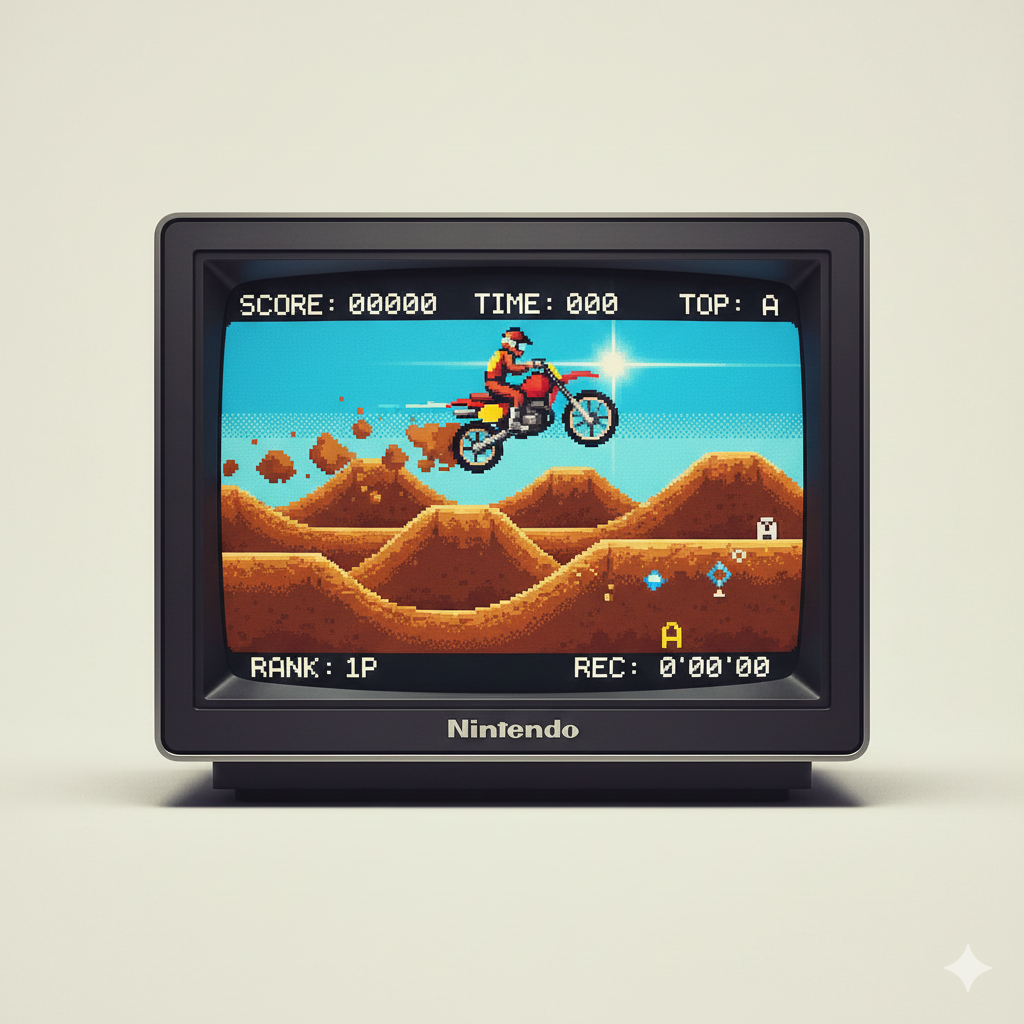
Introduction to Excitebike
Released in 1984 by Nintendo, Excitebike is widely recognized as one of the pioneering motorcycle racing video games in history. Developed for the Nintendo Entertainment System (NES), this classic arcade-style game quickly garnered attention for its innovative gameplay mechanics and engaging graphics. Players navigate rugged tracks filled with obstacles, performing jumps and stunts while racing against competitors, all of which contribute to its reputation as a beloved title among fans of retro gaming.
One of the defining characteristics of Excitebike is its emphasis on player creativity. It allows users to design their own racetracks, a feature that was quite advanced for its time. This customizable element not only increased the game’s replay value but also inspired a sense of ownership and personal expression among players. Furthermore, the game’s vibrant visuals, catchy soundtracks, and iconic NES aesthetics resonate with a generation that grew up with early video gaming.
Excitebike’s significance extends beyond its innovative features; it is a hallmark of the early successes of Nintendo as a developer in the gaming industry. By combining simple controls with challenging gameplay, Excitebike appealed to a wide range of audiences—from casual gamers to those seeking a more competitive experience. The game received positive reviews upon release, and its enchanting mix of speed and stunts created a lasting legacy that influenced subsequent titles in the racing genre.
Today, Excitebike is not only remembered as a nostalgic gem but also celebrated as an important part of video gaming history. It has seen various re-releases and adaptations over the years, demonstrating its enduring appeal and impact on the racing game landscape. The innovation and charm of Excitebike solidify its status as a classic, ensuring its place in both the annals of gaming history and the hearts of fans.
Gameplay Mechanics
Excitebike, a prominent title in the world of retro gaming, is celebrated for its engaging and innovative gameplay mechanics that set it apart from many contemporary titles. At the heart of the game lies its racing mechanics, which involve players controlling a motorcycle across various tracks while navigating a series of obstacles and ramps. The primary objective is to achieve the fastest completion time, but players must also focus on managing their bike’s speed, balance, and acceleration to avoid crashes.
The track design in Excitebike features multiple terrains, each presenting unique challenges. From smooth stretches that allow for high-speed racing to rough patches that require careful maneuvering, the variety in track layouts keeps the gameplay fresh and exciting. Players encounter ramps that enable exhilarating jumps, adding an extra layer of strategy as they land on different sections of the track. Proper timing and positioning during these jumps can significantly influence a player’s overall performance.
An interesting aspect of Excitebike is the inclusion of obstacles such as mud patches and other competitors. These elements serve not only to complicate the racing experience but also demand a level of skill and adaptability from the players. Successfully navigating these challenges requires practice and a deep understanding of the bike’s physics, including the nuances of acceleration and braking. Compared to other racing games of its time, Excitebike stands out due to its unique blend of simplicity and depth, allowing players to explore both casual play and competitive racing through its nuanced mechanics.
The Development Story
Excitebike, a pioneering title in the realm of racing games, was developed by Nintendo and released in 1984 for the Famicom Disk System in Japan. The game was designed under the direction of Shigeru Miyamoto, a prominent figure at Nintendo known for his innovation in game design. The concept for Excitebike emerged from a desire to create an engaging motocross experience that was accessible to players of varying skill levels.
During the early stages of development, Nintendo had limited technological resources. The Famicom hardware presented specific challenges, particularly concerning graphics and processing power. The development team had to innovate within these constraints, opting for a distinctive 2D perspective that allowed for smooth scrolling backgrounds and vivid character animations. This was a crucial design choice that contributed significantly to the game’s appeal.
The design process was iterative, with multiple gameplay aspects requiring fine-tuning. The team conducted various tests to achieve the right balance between simplicity and depth. This included refining the game mechanics, such as throttle control and jumping dynamics, to provide players with a challenging yet rewarding experience. The introduction of custom tracks through the Track Editor feature was revolutionary, allowing players to design their own racing environments and adding endless replayability.
Despite the success of the game, development did not come without its hurdles. The team faced challenges, particularly regarding player feedback. They meticulously adjusted the difficulty level to ensure it remained accessible while also providing enough challenge for seasoned players. Overcoming these obstacles set a foundation for future racing titles that followed in Excitebike’s footsteps.
Graphics and Sound Design
Excitebike, released in 1984 for the Nintendo Entertainment System (NES), is renowned not only for its engaging gameplay but also for its distinctive graphics and sound design that encapsulate the essence of the 8-bit era. The game’s visuals are a quintessential representation of the era’s technology, utilizing a limited color palette that manages to create a vibrant and memorable world. The character sprites, while simplistic, are distinctly recognizable and demonstrate a remarkable level of animation for the time, particularly in how the bikes and riders move and respond to the terrain.
The backgrounds in Excitebike feature a variety of environments that contribute to the sense of speed and excitement. From dirt tracks to elevated sections of challenging obstacles, each course is designed with attention to detail, making excellent use of tile-based graphics. This aesthetic not only serves to enhance the immersive experience but also effectively communicates different gameplay dynamics, such as jumps and ramps, through visual cues that are easy for players to comprehend. The use of parallax scrolling further adds depth to the visual presentation, creating a more engaging atmosphere for players as they race through the levels.
Sound design plays a crucial role in the overall presentation of Excitebike. The chiptune music, composed with the limitations of the NES sound hardware, is catchy and rhythmic, perfectly complementing the fast-paced gameplay. The sound effects, from the revving of engines to the crash noises when players wipe out, add an extra layer of realism and excitement to the game. Each auditory element, meticulously crafted within the constraints, enhances the player’s connection to the game and immerses them in the thrilling world of high-speed dirt biking.
Track Creation Mode
The Track Creation Mode in Excitebike was a groundbreaking feature that allowed players to unleash their creativity and design custom racing tracks. This innovative mode provided a user-friendly interface where players could select and manipulate various elements to create unique racing environments, further enhancing the overall gameplay experience.
The tools available in Track Creation Mode were simple yet effective. Players were given a grid layout that represented the track area, which they could fill with jumps, ramps, and different kinds of terrain. This enabled the creation of a wide variety of tracks, each with its own challenging features. For instance, players could experiment with elevating certain sections of the track or laying out a series of obstacles to test skill levels. The flexibility offered by these tools inspired players to craft imaginative courses that often went beyond the standard designs found in the game.
The reception of the Track Creation Mode was overwhelmingly positive, as players praised the freedom it provided to customize their racing experience. Many found it engaging to test not only their racing skills but also their engineering capabilities by creating tracks that posed unique challenges. This feature allowed for replayability and longevity in the game, as players could share their creations and challenge friends to race on them, leading to a thriving community engaged in track sharing and competition.
Overall, the Track Creation Mode exemplified the innovative spirit of Excitebike, merging creativity with gameplay in a way that appealed to players of all ages, thus cementing its status as a beloved classic in the realm of retro gaming.
Cultural Impact and Legacy
Released in 1984, Excitebike is often heralded as a benchmark in the history of video games, particularly within the racing genre. Developed by Nintendo, the game not only captured the imagination of players but also pioneered several mechanics that would influence future titles. Its unique blend of simplicity and challenge allowed players to build their own motocross tracks, fostering a sense of creativity and personalization that was rare at the time.
The introduction of the track editor in Excitebike provided a revolutionary experience, enabling players to create and share their own custom courses. This was not only innovative but also laid the groundwork for user-generated content in video games, a concept that has since become a staple feature in contemporary gaming. As players found joy in designing their tracks, it also encouraged a competitive spirit among friends, turning local multiplayer sessions into cherished memories.
Furthermore, Excitebike’s influence extended beyond its immediate release, affecting subsequent racing games across various platforms. Titles such as Road Rash and Motocross Madness drew inspiration from Excitebike’s control mechanics and gameplay dynamics. The legacy of this retro classic is evident in the way modern racing games adopt similar elements, ensuring its place as a touchstone for developers seeking to blend arcade fun with elements of realism.
Even decades later, the game’s aesthetics and mechanics resonate with nostalgia among older gamers, while still appealing to new audiences. With its memorable 8-bit graphics and iconic music, Excitebike has embedded itself in the annals of video game history, serving as a reminder of the foundational elements that can yield timeless entertainment. As such, it remains a significant reference point for both game developers and enthusiasts alike, reaffirming its legacy as a critical stepping stone in the evolution of racing games.
Reception and Critique
Upon its release in 1984, Excitebike was met with a largely positive response from both gaming magazines and the player community. As a pioneering title in the racing genre, it captivated players with its innovative gameplay mechanics and ability to design custom tracks, a feature that contributed significantly to its appeal. Magazines such as Computer Gaming World praised the game’s vibrant graphics and the engaging, competitive nature of the races, highlighting how it stood out from contemporaneous titles at the time.
Critics pointed out that the game’s controls were somewhat challenging, particularly for new players. The ability to manipulate acceleration and balance while navigating bumpy tracks required a level of skill that not all players initially possessed. Some reviewers did suggest that this steep learning curve could deter casual gamers, which was a notable critique during the era of arcade-style simplicity.
The unique feature of creating custom tracks received varied feedback. While many players enjoyed the freedom it provided, others found it somewhat limited in scope. Suggestions emerged from fans for a more extensive library of obstacles and terrain variations, which could have enhanced the experience considerably. Furthermore, the absence of multiplayer options in the original version drew some criticism, as participants felt that racing against friends would have amplified the fun.
Despite these critiques, Excitebike succeeded in establishing a dedicated following. Its intriguing gameplay and memorable aesthetics resonated with a generation of gamers and laid the groundwork for future motorcycle racing titles. The game’s legacy has endured, influencing numerous sequels and similar games in the genre. Overall, the reception of Excitebike illustrated a complex interplay of innovative gaming elements and areas that beckoned improvement, culminating in a classic title revered by many.
Excitebike in the Modern Era
Since its release in 1984, Excitebike has remained a notable player in the retro gaming landscape, captivating audiences with its simple yet engaging gameplay. Over the years, this classic title has not only maintained its charm but has also adapted to the evolving gaming environment through various re-releases and adaptations. The game’s legacy has been preserved on modern platforms, enabling a new generation of gamers to experience its unique mechanics.
In 2007, Nintendo made strides to reintroduce Excitebike to audiences by including it in the Wii’s Virtual Console. This release allowed players to access the original game, complete with its iconic 8-bit graphics and challenging motocross gameplay, all while taking advantage of the Wii’s innovative controls. Additionally, the game was also included in the launch of the Nintendo 3DS Virtual Console, making it available for handheld gaming enthusiasts. These efforts demonstrate Nintendo’s commitment to keeping its retro catalog alive.
More recently, the release of Excitebike 64 on the Wii U Virtual Console further showcased the franchise’s enduring appeal. The improved graphics and gameplay mechanics in this sequel provided a fresh experience while still honoring the original title’s spirit. Furthermore, Excitebike has inspired a range of related games and sequels within the franchise, showcasing its lasting impact on the racing genre and the nostalgia it incites among gamers.
The continued popularity of Excitebike among retro gamers can be attributed to its straightforward mechanics and the joy of creating custom tracks. Fans often reminisce about their experiences, sharing memories that span generations. This connection to the past, paired with the availability of the game on modern systems, ensures that Excitebike’s legacy will endure as a testament to its initial brilliance.
Conclusion: The Enduring Appeal of Excitebike
Excitebike, originally released in 1984, remains a captivating classic that has stood the test of time. Its unique blend of simplicity, challenge, and creativity continues to draw both nostalgic players and newcomers alike. The game’s innovative concept of designing custom tracks allows players to express their creativity while competing against themselves or others, fostering a sense of engagement that is often lacking in modern gaming experiences.
The charm of Excitebike lies not only in its straightforward gameplay mechanics but also in its vibrant graphics and memorable audio. The pixelated visuals, coupled with catchy sound effects, evoke a sense of nostalgia for those who grew up in the era of 8-bit gaming. This retro aesthetic has inspired a revival in interest among gamers seeking a break from hyper-realistic graphics, demonstrating that sometimes less is more.
Furthermore, Excitebike’s accessibility makes it an ideal entry point for those new to video games. Its controls are easy to grasp, allowing players of all ages to enjoy the adrenaline of racing. The absence of complex narratives or overwhelming tutorials enables players to jump right into the action, making each race feel accessible and immediate. This simplicity contributes to its lasting appeal, as gamers today often seek experiences that do not require a significant time investment.
In appreciation of Excitebike, it is essential to encourage new players to explore this retro gem. By experiencing its gameplay, one not only enjoys the thrill of racing but also gains insight into the evolution of video games. Whether revisiting the classic or diving in for the first time, players will find themselves immersed in an engaging world of fun and creativity. Excitebike is not just a game; it is a testament to the enduring nature of classic gaming.