
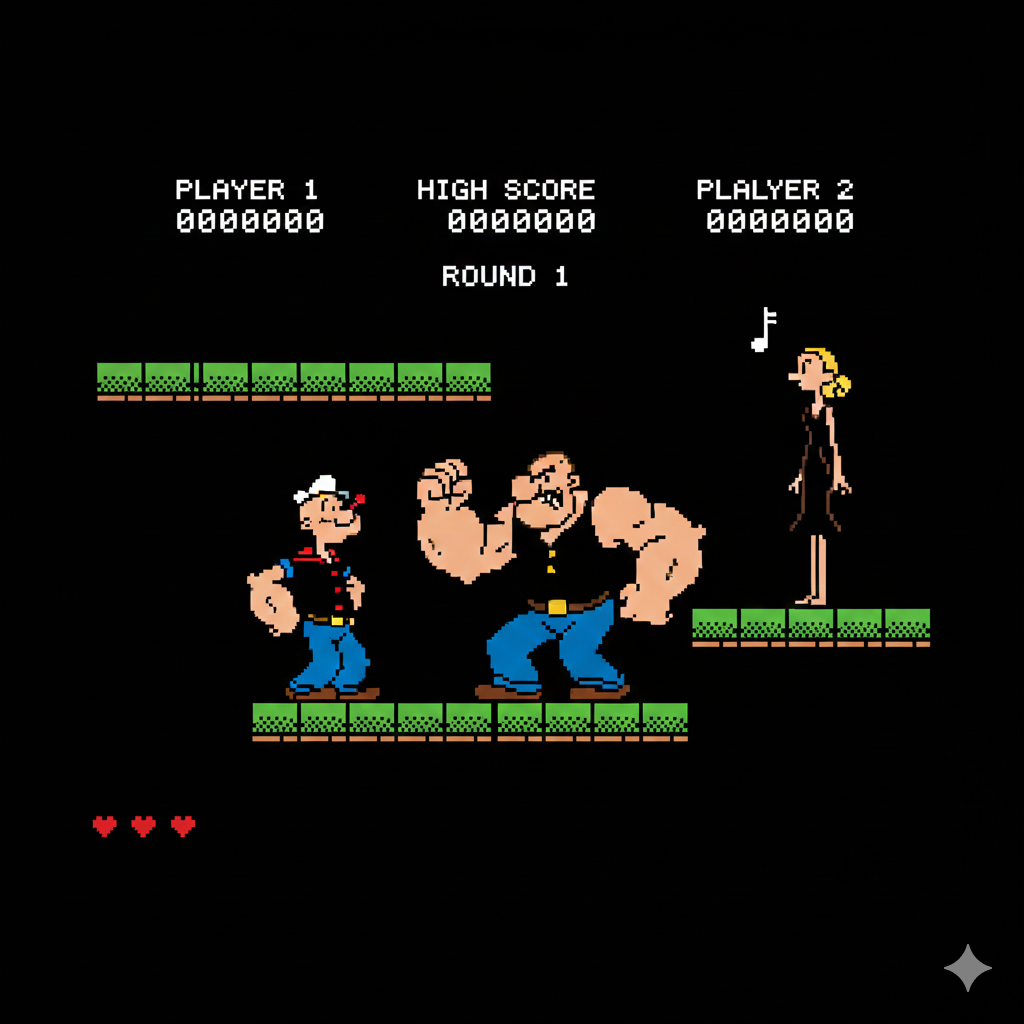
Introduction to Popeye: A Gaming Icon
The 1983 Nintendo game, Popeye, stands as a notable landmark in the world of video gaming, demonstrating the significant impact of cartoon characters on interactive entertainment. This game draws upon the beloved Popeye cartoon series, characterized by its unique blend of humor and adventure. Created by the renowned animator Elzie Crisler Segar, Popeye first appeared in comic strips in the 1920s, later transitioned to animated shorts, and eventually became a gaming icon. The video game adaptation brought this nostalgic character into the homes of millions, captivating audiences of all ages.
Popeye made its debut on the Nintendo Entertainment System (NES), offering a platform for players to engage directly with the cartoon’s narrative. Players take on the role of Popeye, navigating through various levels to rescue Olive Oyl from the clutches of Bluto, who represents the quintessential villain in the Popeye saga. The gameplay is characterized by a straightforward yet engaging format, where players collect items and avoid obstacles, a mechanic that ensures both children and adults find enjoyment in each session.
The game’s design and mechanics reflect a unique charm that was prevalent in the Americana of its time. Leveraging Popeye’s popularity, the game connected with players not only through recognizable characters but also through enjoyable gameplay, rich with vibrant graphics and stimulating challenges. This combination of engaging storylines and interactive mechanics solidified the game’s significance and established Popeye as a memorable fixture in the gaming landscape.
Ultimately, the Popeye game serves as a testament to the enduring legacy of animated characters, showcasing how they can successfully transition into other mediums. As gaming evolved, titles like Popeye played an essential role in bridging the gap between traditional cartoons and the burgeoning interactive entertainment industry, influencing generations to embrace both gaming and animated storytelling.
The Gameplay Experience
The 1983 Nintendo game Popeye offers a unique gameplay experience that challenges players to immerse themselves in the animated world of the beloved cartoon character. In this particular game, players take on the role of Popeye, who must navigate through a series of levels filled with obstacles and adversaries, particularly his longtime rival, Bluto.
Controlling Popeye is straightforward, utilizing the joystick to guide him through various platforms. The objective is primarily focused on collecting specific items, such as hearts, which represent Olive Oyl’s affection. These items are scattered throughout each level but are not easily attainable, as players must be vigilant and strategic in their movements to avoid the challenges presented by Bluto and other threats.
The game is structured in a manner that encourages players to develop their reflexes and timing. Each level introduces new dynamics; for instance, players may find themselves climbing ladders to reach items while simultaneously dodging Bluto, who relentlessly pursues them. The tension arises from the necessity to collect items quickly while maintaining awareness of Bluto’s movements, adding an element of excitement to the gameplay. Unique to Popeye, players must engage with environmental features, such as moving platforms and hazards, which require agility and precise control.
Moreover, the gameplay is enriched by sound effects and visuals that reflect the vibrant charm of the original Popeye cartoons. Each successful collection of items rewards players with points, fostering a competitive spirit as they strive to achieve high scores. This mix of collectible objectives and evasion mechanics not only makes the gameplay addictive but also contributes to the game’s lasting appeal among generations of players.
Character Analysis: Popeye and Friends
The classic Nintendo game “Popeye,” released in 1983, derives its charm from the rich personalities of its titular character and his supporting cast. At the heart of the game is Popeye himself, a character who embodies resilience and determination. Known for his iconic strength that manifests after consuming spinach, Popeye’s keen sense of justice is evident in his quest to rescue Olive Oyl from the clutches of Bluto. His character extends beyond mere physical prowess; it encapsulates a deep-seated moral compass that drives him to protect those he loves.
Olive Oyl, as depicted in the game, is not merely a damsel in distress but plays a pivotal role that reflects her animated series portrayal. She exudes an independence that often sees her caught in a love triangle with Popeye and Bluto. In the game, her character serves as the motivational force for Popeye, inspiring his relentless efforts to save her. This dynamic adds a layer of complexity to her character, showcasing her as a figure of strength rather than just vulnerability.
Bluto, the antagonist of the game, represents the quintessential brute force often opposing Popeye. Although his character seems one-dimensional at first glance, he can be interpreted as a foil to Popeye’s heroism. Bluto’s obsession with capturing Olive Oyl propels the conflict that drives the gameplay forward, illustrating a classic battle between good and evil. While he embodies the characteristics of a traditional villain, his motivations can offer insights into the darker aspects of desire and rivalry.
The interrelationships between Popeye, Olive Oyl, and Bluto serve as a foundational element of the game, reflecting their roles from the beloved animated series. These character adaptations highlight the themes of love, conflict, and moral integrity that are present in the franchise, effectively allowing new players to engage with these iconic figures while immersing themselves in a nostalgic experience.
The Graphics and Sound of Popeye
The 1983 Nintendo game, Popeye, is a remarkable representation of pixel art that effectively captures the charm and whimsy of the beloved cartoon. The graphics exhibit vibrant colors and simple, yet engaging designs that evoke nostalgia for fans of the Popeye franchise. The careful attention to detail in the character sprites, including Popeye himself, Olive Oyl, and Bluto, conveys the unique attributes that define each persona, allowing players to instantly recognize them.
The backgrounds of the game are also noteworthy; they are designed to create a lively atmosphere that immerses players in the world of Popeye. Various levels take players through settings like the dockside and the restaurant, with animations that enhance the visual storytelling. This use of pixel art not only pays homage to the original animation style but also leverages the technological capabilities of the time, providing a delightful experience without overwhelming players with complexity.
In addition to the striking visual elements, the sound design in Popeye plays a significant role in shaping the gaming experience. The catchy background music aligns with the playful nature of the game, incorporating melodies that evoke a sense of familiarity for those acquainted with the cartoon. The sound effects, ranging from Popeye’s iconic ‘sailor’s laugh’ to the clinking of dishes as players interact with objects, further enrich the environment and add depth to the gameplay. These auditory elements work in tandem with the graphics to create a cohesive and enjoyable experience, solidifying Popeye’s status as a classic Nintendo title that resonates with generations of players.
Cultural Impact and Legacy
The 1983 Nintendo game Popeye has left a significant imprint on the landscape of video games, shaping both the platforming genre and popular culture. This iconic game, based on the beloved cartoon series, captured the imaginations of players and has influenced a multitude of future platformers. Its engaging mechanics and charming presentation blended seamlessly with the character-driven narratives that many games adopted in the years following its release.
Popeye introduced a unique combination of action and puzzle elements that became staples in later platformers. Players needed to navigate various obstacles while collecting items, a gameplay mechanic that has since been seen in numerous franchises, such as Sonic the Hedgehog and Super Mario. This paradigm set the stage for developers to innovate within the genre, drawing inspiration from Popeye’s simple yet captivating approach to gameplay.
The game remains a touching point of nostalgia for those who experienced its release. References to Popeye have continually appeared in various media, reaffirming its cultural relevance even decades later. Modern remakes and adaptations of the game echo its enduring popularity, ensuring that new generations are introduced to its charm. This legacy extends to merchandise, collaborations, and fan communities that keep the spirit of Popeye alive in contemporary gaming culture. Players often reminisce about their experiences with the game, highlighting its crucial role in shaping their initial gaming experiences.
In exploring the cultural impact of the 1983 Popeye game, it becomes clear that it has not only endured the test of time but has also contributed to a broader appreciation for video games as an art form. Its legacy continues to inspire a new wave of game developers while igniting a passion in players that bridges the gap between generations.
Comparing Popeye to Other Nintendo Classics
The 1983 Popeye game by Nintendo stands out as an engaging title that not only captivated many players during its release but also contributed to the tapestry of gaming history alongside other iconic Nintendo classics of the same era such as Donkey Kong, Super Mario Bros., and The Legend of Zelda. Each of these games contributed uniquely to the industry, showcasing different gameplay mechanics and narrative styles.
Much like Donkey Kong, which was released in 1981, Popeye features a straightforward yet addictive gameplay structure where players navigate through various levels while overcoming obstacles. In Popeye, players embody the eponymous sailor as he strives to gather hearts while avoiding the antagonistic Bluto, creating a chase dynamic akin to that seen in Donkey Kong, where Mario must save Pauline from the titular ape. However, unlike Donkey Kong’s vertical levels, Popeye employs lateral movement, requiring players to traverse platforms to collect items.
In terms of graphics, Popeye utilizes a vibrant color palette and simple, recognizable character designs, reflecting the era’s visual aesthetics. The character sprites are distinct yet simplified, similar to the graphical treatment seen in Super Mario Bros., which was released a year later. While Nintendo’s iconic plumber has since become synonymous with platform gaming, Popeye’s graphical approach was critical at the time, establishing a foundation for future platformers with its emphasis on character identity.
Storytelling in Popeye is succinct, revolving around a familiar cultural narrative of love and rivalry, similar to the tales found in The Legend of Zelda. However, unlike the quest-driven narrative of Zelda, Popeye takes a more light-hearted approach, focusing on fun gameplay over a richly detailed storyline. This differentiation is a testament to the diversity in gaming experiences available in the early ’80s, highlighting Popeye’s role as an accessible entry point for younger audiences.
Tips and Tricks for Mastering Popeye
Mastering the classic Nintendo game, Popeye, requires a combination of strategy and practice. To navigate the game’s challenging levels effectively, players should familiarize themselves with the layout of each stage. Understanding how items and hazards are positioned will greatly enhance gameplay.
One of the most crucial benefits in Popeye is the use of collected items. Players should prioritize gathering hearts and other collectibles, as these not only score points but also serve as essential tools in progressing through levels. Additionally, it is advisable to keep an eye on the location of Olive Oyl, the damsel in distress, as her position can guide the player’s movement and decision-making.
To avoid hazards—such as the ever-present Bluto and various obstacles—timing is critical. Players should develop a rhythmic approach to dodging threats. For instance, instead of rushing forward, take time to observe enemy patterns; this can help anticipate their movements. Understanding the timing of hazards is vital for survival in the game.
Utilizing the game’s mechanics is also key to success. For instance, jumping over obstacles can often be more effective than trying to maneuver around them, especially in close quarters. Players should practice the jump feature to maximize their agility. Furthermore, using the pause button can give players the time needed to plan their next move, especially in chaotic situations.
Lastly, practice makes perfect. Engaging with Popeye regularly will help players hone their skills, improve their timing, and develop strategies unique to their gameplay style. Watching seasoned players can also offer new insights and techniques, adding to a player’s overall toolkit.
Fan Reactions and Community
The cultural impact of the classic 1983 Nintendo game, Popeye, continues to resonate within the gaming community decades after its release. Online forums and social media platforms serve as vibrant hubs for fans to share their experiences and recollections about this iconic game. Players of all ages fondly remember the thrill of navigating obstacles while collecting spinach and avoiding Bluto, sparking nostalgic discussions among newcomers and veterans alike.
Many fans express their love for the game through various forms of fan art, showcasing their creativity inspired by Popeye and his adventures. Websites such as DeviantArt and Reddit are filled with submissions, from detailed illustrations to humorous reinterpretations of classic scenes. One fan remarked, “Popeye was my childhood! Every time I see someone draw Bluto, I can’t help but smile and remember those endless afternoons spent with my friends at the arcade.” This attachment to the game highlights its enduring charm and the way it has remained a cherished part of many gamers’ histories.
Community events and retro gaming conventions also demonstrate the lasting love for the Popeye game. Panels often feature discussions about its influence on later titles and how it paved the way for future adaptations of animated properties into video games. Participants frequently share anecdotes that reveal their personal connections to the game, underscoring the profound emotions associated with their experiences. As one attendee from a recent convention expressed, “It was more than just a game; it was a bonding experience with my family and friends that I will always treasure.” These heartfelt sentiments reflect the powerful nostalgia that the Popeye Nintendo game continues to inspire across generations.
Conclusion: The Timelessness of Popeye
The 1983 Nintendo game Popeye holds a distinct place in gaming history, capturing the hearts of players with its unique blend of humor, simplicity, and engaging gameplay. By combining recognizable characters from the beloved animated series with innovative game mechanics, it not only entertained players but also established a foundation for future adaptations of animated franchises in gaming. With music that resonates through nostalgia and visuals that evoke fond memories, it successfully sustains its charm across generations.
What truly sets Popeye apart is its effortless apply of engaging gameplay similar to what players experience today. The objective-centered design, involving the collection of items while simultaneously dodging antagonistic characters, proved to be a compelling formula. This strategic combination of elements has influenced countless games that followed, emphasizing the importance of challenge and rewards in video game design.
The enduring legacy of Popeye can be attributed to its ability to evoke feelings of nostalgia, inviting both older and newer generations to experience its simple joys. The game’s straightforward concept makes it accessible to a wide audience, ensuring that even those unfamiliar with the franchise can enjoy the experience. Furthermore, the incorporation of iconic elements such as spinach as a power-up encapsulates the inescapable connection between gameplay and popular culture.
Ultimately, Popeye’s timelessness lies in its inspirational design and the emotional resonance it cultivates. It serves as a reminder of the early days of gaming, illuminating the path for subsequent innovations while continuing to delight fans, young and old alike. By appreciating its historical significance, players can celebrate the impact this classic title has had on the gaming community and the memories it continues to create.