
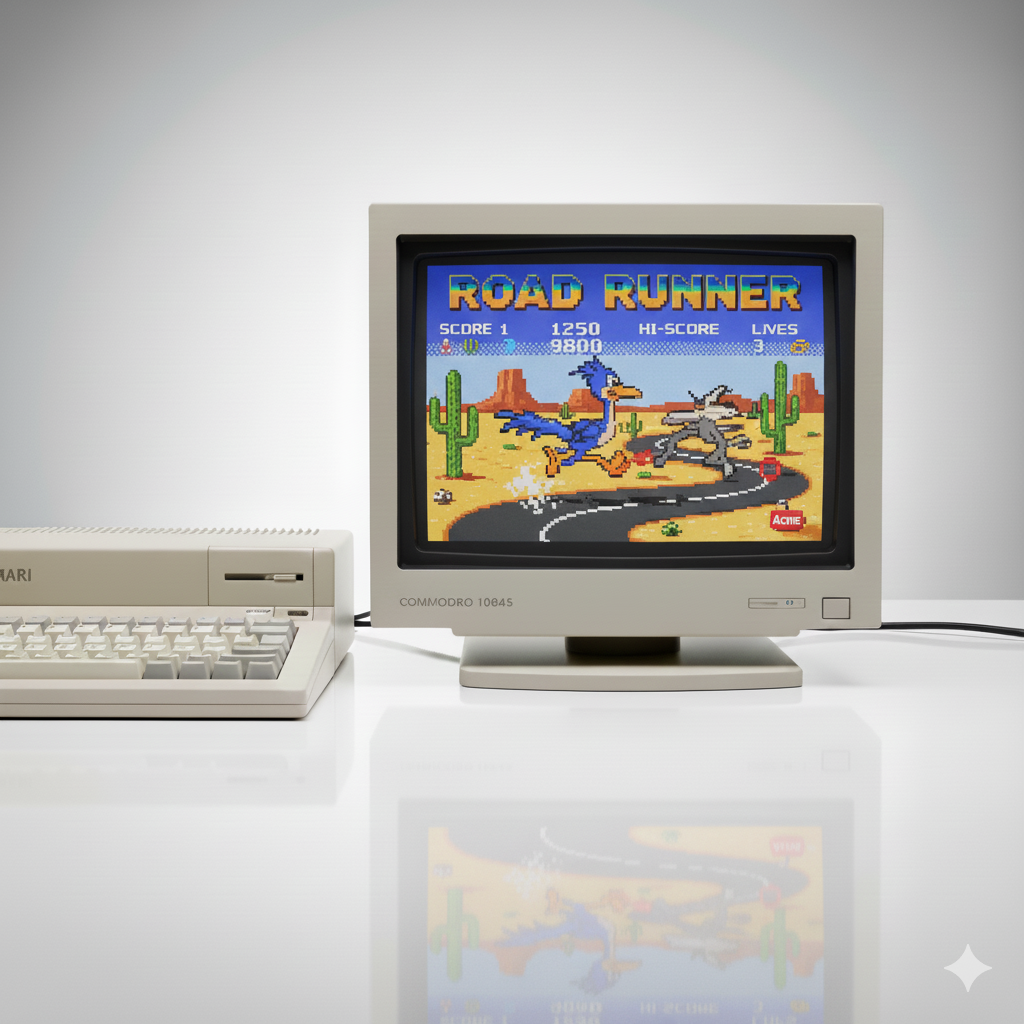
Introduction to Road Runner
The classic Atari game, Road Runner, was first released in 1985 and became a notable title during the golden era of arcade games. Developed by Atari Games, the game features the iconic Looney Tunes character, Road Runner, who is incessantly chased by the crafty Wile E. Coyote. This dynamic duo, cherished by fans since their television debut, adds a playful narrative to the fast-paced gameplay.
In Road Runner, players engage in a vibrant and colorful environment that mirrors the humor and spirit of the cartoons. The primary objective is to navigate through a series of levels while avoiding various traps set by Wile E. Coyote. The game allows players to experience the thrill of speed and agility that Road Runner is known for, further immersing them in the whimsical world of Looney Tunes.
Gameplay Mechanics and Objectives
Road Runner, a hallmark in the classic arcade game genre, presents a fast-paced gameplay experience that draws players into the vibrant world of the beloved cartoon. The primary objective is straightforward: players assume the role of the iconic Road Runner, tasked with outsmarting the ever-persistent Wile E. Coyote. The goal is not only to navigate through various levels but also to avoid the traps and obstacles set by Coyote while collecting items that enhance the player’s score.
The controls in Road Runner are intuitively designed, allowing players to move the character with precision. For instance, players can accelerate quickly to dodge threats or perform short bursts of speed to evade the Coyote’s antics. The control scheme includes basic movements such as running left and right, while special actions, like jumping over obstacles, further enrich the gameplay. Mastery of these controls is essential for advancing through the game’s progressively challenging stages.
As players venture through the desert landscape, they will encounter various challenges, including falling rocks, cacti, and, of course, Wile E. Coyote himself attempting to catch them. The timing and rhythm of movements play a crucial role in avoiding these hazards, which demand quick reflexes and strategic thinking. Additionally, collecting power-ups throughout the levels enhances the gameplay experience, providing temporary advantages or bonuses that can tip the scales in favor of the player.
Ultimately, the charm of Road Runner lies in its ability to engage players in a light-hearted yet challenging race against Wile E. Coyote. The combination of skillful navigation, collecting items, and evading traps creates a rich gaming experience that has stood the test of time in the annals of classic gaming. The blend of simple mechanics with increasing complexity ensures that players remain captivated throughout their journey.
Characters and Their Roles
Road Runner and Wile E. Coyote are two iconic characters that embody the essence of the classic Atari game, Road Runner. Their dynamic is centered on a classic chase that continues to engage players through its humor and strategy.
The Road Runner, often represented by its trademark “Meep Meep” call, is the embodiment of speed and agility. In the game, the Road Runner’s primary role is that of the protagonist, where it must navigate various terrains while eluding the clever traps set by Wile E. Coyote. The character’s ability to outsmart and outrun its foe not only exemplifies its heroic instincts but also symbolizes freedom and resilience against persistent adversities. Players control the Road Runner, utilizing its speed to gather items and achieve goals while maintaining an ever-watchful eye on the cunning coyote.
Wile E. Coyote serves as the antagonist, renowned for his ingenious yet futile schemes to capture the elusive Road Runner. His character is defined by a series of elaborate traps and elaborate strategies that often backfire spectacularly. The archetype of an ambitious but unlucky villain, Wile E. Coyote demonstrates determination and inventiveness. His various contraptions, borrowed from the fictional Acme Corporation, add a layer of comedy to the gameplay, as players witness the continuous cycle of failure in his pursuit. The charm of Wile E. Coyote lies in his relentless optimism, making him a beloved character despite his role as the pursuer.
Overall, the interactions between Road Runner and Wile E. Coyote create a rich tapestry of challenge and entertainment. Through their contrasting roles, the game captures themes of perseverance, ingenuity, and the timeless appeal of the chase, making these characters memorable staples of gaming history.
Visuals and Sound Design
The visual aesthetic and sound design of the classic Atari game Road Runner significantly contribute to the overall gaming experience. Released during a period characterized by limited graphical capabilities, Road Runner showcases a distinct artistic style that remains memorable among players. The graphics are representative of 8-bit technology, yet they effectively capture the vibrant essence of the cartoon characters and environments.
Character designs are immediately recognizable, featuring the iconic Road Runner and Wile E. Coyote. The bright colors and simple animations effectively communicate each character’s personality and movement, providing an engaging interface for players. The backgrounds are intricately designed to reflect the southwestern desert landscape—full of prickly cacti and rocky terrain—which serves as a fitting setting for the intense chase sequences. The use of parallax scrolling enhances the depth of the visuals, although limited by the hardware, creators made clever use of color gradients to create a sense of distance.
Moreover, the sound design of Road Runner plays a crucial role in immersing players into the game world. The catchy and upbeat soundtrack complements the fast-paced nature of gameplay, encouraging players to navigate through challenges quickly. Sound effects, such as the well-timed beeps of the Road Runner or the comical splats associated with Wile E. Coyote’s antics, add an additional layer of humor and excitement. The clever integration of sound effects with visual cues helps reinforce the gameplay mechanics, making for a cohesive experience.
In conclusion, the visuals and sound design of Road Runner effectively create a unique and engaging atmosphere that enhances the enjoyment of the game. This combination of eye-catching graphics and lively audio not only captures the essence of the beloved cartoon characters but also establishes the game as a noteworthy entry in the Atari catalog.
Cultural Impact and Legacy
The classic Atari game, Road Runner, has made a significant mark not only within the realm of video gaming but also in the broader context of pop culture. Released in the early 1980s, the game captured the essence of the beloved Looney Tunes characters, particularly focusing on the iconic Road Runner and his adversary, Wile E. Coyote. This blend of vibrant graphics and engaging gameplay contributed to its status as a cherished piece of nostalgia for many gamers.
Road Runner played a pivotal role in shaping the landscape of platform games during its time. Its fast-paced mechanics encouraged players to think strategically and react quickly, influencing the design of numerous subsequent games in the platform genre. The emphasis on speed, combined with cleverly designed stages, encouraged a level of competition among players that was relatively novel in early gaming. Its simplistic yet effective design principle has continued to inspire game developers who seek to capture the spirit of fun and competition that Road Runner embodies.
Furthermore, the game’s integration into the Looney Tunes franchise expanded its cultural significance. As one of the earliest examples of a licensed video game, Road Runner paved the way for future intersections of gaming with established entertainment properties. This strategy resulted in the proliferation of Looney Tunes merchandise and solidified the brand’s relevance in various media formats. The game not only attracted a diverse audience of gamers but also appealed to fans of the cartoons, illustrating the potential of video games as a viable extension of popular franchises.
In conclusion, the legacy of Road Runner is evident in its lasting appeal and its influential role in video game design. It remains a classic example of how video games can transcend mere entertainment, offering cultural significance and shaping perceptions of beloved characters in new and engaging ways.
Tips and Strategies for Players
For new players of the classic Atari game, Road Runner, effective play involves strategic thinking and a good understanding of the game’s mechanics. One of the crucial strategies is to learn the patterns of Wile E. Coyote’s movements. He typically follows a predictable trajectory, which players can anticipate and use to their advantage. When navigating the levels, it is essential to keep an eye on Coyote’s approach, allowing players to maximize their escape routes and stay ahead of danger.
In addition to evading Wile E. Coyote, collecting items is a vital aspect of the game. Players should take time to explore each level thoroughly, as power-ups and scores can significantly enhance gameplay. Keep in mind to always prioritize collecting the Acme gadgets, which not only aid in avoiding Coyote but also help in overcoming obstacles throughout various levels. A strategic approach to item collection can vastly improve one’s performance, enhancing the overall game experience.
Mastering levels requires practice and familiarity with each stage’s layout. Players should observe the environment for hints and potential hazards, as well as the locations of special items needed to progress. Utilizing quick reflexes is critical, especially during moments when Wile E. Coyote is in close pursuit. Learning to correctly time jumps and maneuvers can easily be the difference between advancing to the next level or having to restart from a previous checkpoint.
To summarize, success in Road Runner involves understanding character patterns, efficiently collecting items, and mastering level designs through practice. Adopting these strategies can enhance the enjoyment of the game, making it a rewarding experience for both beginners and seasoned players alike.
Comparisons with Other Atari Games
The Classic Atari game Road Runner not only captivated players with its engaging gameplay but also established itself uniquely when compared to other prominent games of its time. Notably, Atari games like Pong, Pac-Man, and Space Invaders featured distinct gameplay styles and themes, contributing significantly to the retro gaming landscape.
Pong, for instance, was a simplistic yet addictive sports simulation that focused on two-dimensional paddle mechanics, appealing to a broad audience without the complex narratives or character development present in Road Runner. Similarly, Pac-Man introduced maze-like exploration and strategic ghost evasion, which starkly contrasted with Road Runner‘s open-world chase dynamics and character-driven gameplay. In addition, Space Invaders brought a sense of impending doom through leveled progression, enhancing the urgency of gameplay but again differing from the whimsical chase theme established in Road Runner.
What truly sets Road Runner apart is its combination of humor and unique graphics. Utilizing vibrant and cartoonish visuals, the game leveraged the popularity of the Warner Bros. franchise to create a lighthearted gaming experience, differentiating it from the more serious and battle-centric themes seen in games like Defender and Asteroids.
Furthermore, the chase mechanics of Road Runner, where players must evade Wile E. Coyote and collect items along the way, highlights a dynamic of constant movement and strategy that was not as prevalent in its contemporaries. This approach not only reflects the comical nature of the cartoon source material but also innovates on traditional gameplay by emphasizing speed and dexterity. Thus, the elements integrated into Road Runner have earned it a notable place in gaming history, helping it resonate with players beyond the typical arcade experience associated with many Atari games.
The Road Runner Fan Community
The community surrounding the classic Atari game, Road Runner, is a vibrant tapestry of enthusiasts who share a mutual appreciation for this iconic title. Over the years, numerous forums have emerged, allowing fans to discuss strategies, gameplay tips, and nostalgic memories related to the game. Notable platforms such as Reddit and dedicated gaming forums host active threads where players exchange insights about their experiences, celebrate milestones, and offer assistance to newcomers. Such discussions not only foster a sense of camaraderie among players but also help newer fans better understand the game’s nuances.
Furthermore, the online presence of the Road Runner fan community has led to the creation of various fan-generated content. From fan art to gameplay videos, the creativity displayed by the community is remarkable. YouTube channels dedicated to retro gaming frequently feature playthroughs and reviews of Road Runner, often highlighting unique strategies and easter eggs. These video creators contribute greatly to the game’s cultural legacy, ensuring that even new generations have access to its charms.
Events also play a pivotal role in cultivating community spirit. Occasionally, gaming conventions and retro gaming events feature Road Runner-themed activities, ranging from tournaments to Q&A sessions with industry veterans who worked on the game. Such gatherings not only celebrate the game’s history but also allow fans to meet in person, share their passion, and create lasting friendships. Overall, the Road Runner fan community exemplifies the enduring impact of a classic game, ensuring that its legacy continues through enthusiastic discussions, creative adaptations, and memorable events.
Conclusion and Reflections
As we reach the end of our exploration into the iconic Atari game, Road Runner, it is evident that this classic title holds a special place in the hearts of gamers. From its engaging gameplay to its charming graphics and beloved characters, Road Runner represents a significant era in video gaming history. Over the years, its influence has been felt within the gaming community and beyond. This has allowed it to maintain a remarkable relevance amid the vast evolution of video games.
Throughout the discussion, we have delved into the unique mechanics that define Road Runner, examining how the game’s unconventional approach to scoring and player interaction sets it apart from its contemporaries. The atmosphere created by the vibrant depictions of the desert landscape combined with the lively sound effects contributes significantly to the immersive experience that players cherish. The clever design and humor inherent to the game showcase the creativity of the era and underline the timeless nature of its appeal.
Moreover, Road Runner’s character, embodying the spirit of speed and agility, serves as an enduring symbol for gamers looking for a lighthearted yet challenging experience. The dynamics between Road Runner and his nemesis, Wile E. Coyote, propel the narrative, making it not just a platforming game but also a story that resonates with a wide audience. As new technology gives rise to advanced gaming experiences, it is important not to overlook the classics that laid the foundation for today’s innovations.
Ultimately, revisiting Road Runner allows both seasoned players and new audiences to reconnect with this timeless adventure. Rediscovering its charm can provide a refreshing break from the complexities of modern gaming. As such, we encourage readers to either relive those cherished moments or experience Road Runner for the first time, embracing the nostalgia and fun it brings to the forefront of gaming culture.